ADC Modes
The Ndigo5G-10 quantizes the input signal to 8 bits. However, the board always scales and offsets the data to 16-bit signed data centered around 0.
Data processing such as trigger detection or packet building are always performed on 3.2 ns intervals. Depending on the ADC mode, this interval may contain 4, 8 or 16 samples.
The board supports using one, two or four channels.
1-Channel Modes A, B, C, and D
In these modes, only a single channel is used. The analog signal on that channel is digitized at 5 Gsps.
Packet size is always a multiple of 16 samples per 3.2 ns.
Figure 7 shows the signal routing for this mode.
Figure 13 in Trigger Blocks shows triggering in 1-channel mode.
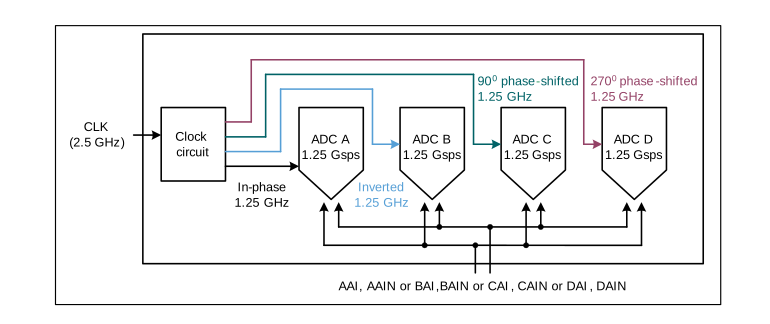
Figure 7 ADCs in 1-channel mode, interleaved for 5 Gsps.
2-Channel Modes AC, BC, AD, and BD
In these modes, two channels are used simultaneously. The analog signals on these channels are digitized at 2.5 Gsps each.
Packet size is always a multiple of 8 samples per 3.2 ns.
Figure 8 shows the signal routing for this mode.
Figure 14 in Trigger Blocks shows triggering in 1-channel mode.
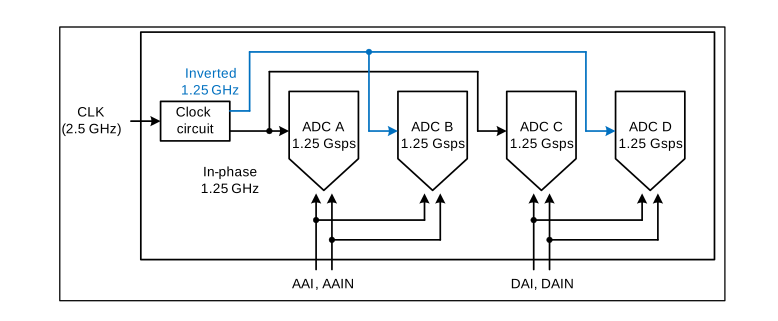
Figure 8 ADCs in 2-channel mode, interleaved for 2.5 Gsps.
4-Channel Mode ABCD
In this mode, all four channels are digitized independently at 1.25 Gsps each.
The packet size is always a multiple of 4 samples per 3.2 ns.
Figure 9 shows the signal routing for this mode.
Figure 15 in Trigger Blocks shows triggering in 1-channel mode.
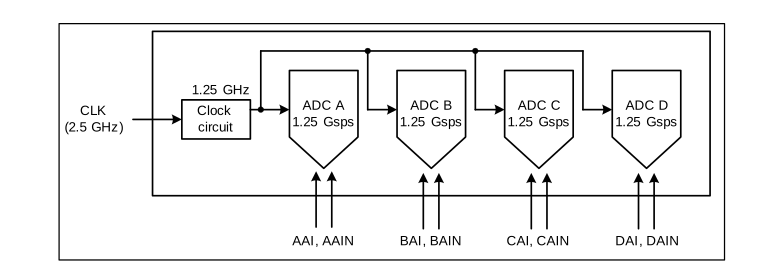
Figure 9 ADCs in 4-channel mode, interleaved for 1.25 Gsps.
Multiple-Sampling Modes AAAA, BBBB, CCCC and DDDD
In these modes, only one analog input channel is used, but the channel is sampled independently and simultaneously by the four ADCs at 1.25 Gsps.
The board creates four independent streams with 4 samples each per 3.2 ns.
Using the same trigger setting on all ADCs, the multi-sampling modes can be used to reduce noise by averaging the four channels.
To deal with complex triggering conditions, different trigger settings on each of the ADCs can be used.
The Ndigo5G provides 4 ADCs sampling at 1.25 Gsps each. Higher speed modes are implemented by interleaving two or four of these ADCs.
During interleaving, the Ndigo5G firmware reorders and groups the data into a linear sample stream. The process is fully transparent.
For users, the only difference is that a 3.2 ns cycle can contain 4, 8 or 16 samples, depending on the mode.