Application Note – Quantization vs. Jitter
In this App-Note
In this application note, we will highlight the effects of quantization errors and jitter on time-to-digital converters.
Performance Test - Measuring a constant delay
Measuring a constant delay is a good way to test the performance of a time-to-digital converter (TDC), such as the xHPTDC8, xTDC4, and TimeTagger4 devices sold by cronologic.
One way to measure constant delays is to repeatedly measure the delay caused by a long cable: A signal is split into two. Then, the timing of the first signal is measured by the start channel of the TDC. The second signal is delayed by sending it through a long cable, then its timing is measured by the stop channel. This measurement is repeated many times and a histogram is filled with the measured difference of the stop time minus the start time.
The shape of the output histogram will depend on two factors: the bin size and the accuracy of measuring the exact start and stop times. In particular, the ratio between bin size and accuracy will be of interest in this application note.
The distinction between the two factors is critical, as we will show in this application note. The bin size causes a quantization error. Other error sources that keep us from accurately measuring real times are referred to as jitter. Jitter can be caused by many things, for example, it may be the caused by the jitter of an external reference clock, the different triggering times of the start/stop channels due to noisy signals, or unequally and unknown sized TDC bins. All these errors are combined and are simply referred to as “jitter” throughout this application note.
Note
In this application note, everything will be given in units of the bin size, that is, the bin size is 1.
Case 1 - Perfect TDC
For reference, let’s assume we have a perfect TDC that has absolute accuracy, that is, absolutely no jitter is present. Such a TDC quantizes continuous times perfectly into discrete bins (here, of bin size 1).
As an example, let’s say we want to measure a constant delay of dT = 100.3. Using asynchronous (to the TDC’s reference clock) start times tstart means that the start times are effectively random, but the stop times are fixed at tstop = tstart + dT.
In our example of dT = 100.3, we will get two possible measurements: 100 and 101. To understand this, consider the following two start times
- Example 1: tstart = 0.1 and tstop = 0.1 + 100.3 = 100.4
Due to the quantization of times into bins of size 1, the TDC will measure tstart,TDC = 0, tstop,TDC = 100, and dTTDC = 100 – 0 = 100.
- Example 2: t0 = 0.9 and t1 = 0.9 + 100.3 = 101.2
Now tstart,TDC = 0, tstop,TDC = 101, and dTTDC = 101 – 0 = 101.
Note that in the two examples above, there are no error sources besides the quantization error. A perfect TDC will always measure two discrete values for a constant delay (unless the delay is an exact multiple of the bin size) and the relative intensity of these values depends on the actual delay.
The following graphic shows the final histogram after simulating one million measurements of various dT with a perfect TDC. As one can see, the relative intensity of the bins changes, but there are always two bins in the histogram.
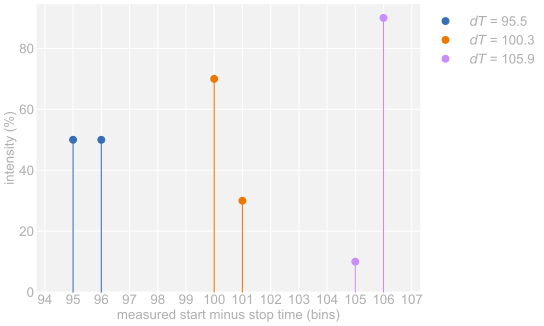
Note that from the above histogram, one cannot estimate the error that results from general jitter, as the histogram is purely the result of the quantization. For example, the standard deviation of the blue data (with dT = 95.5) is 0.5, however, timing errors due to general jitter are zero (as per definition of the simulation).
Case 2 - TDC dominated by jitter
Let us now consider a TDC that has comparably (to the bin size) large jitter.
In the following figure, a simulation of many TDC measurements of a constant delay of 100.3 are shown with increasing jitter. This is done by adding random errors to tstart and tstop before measuring them. The random errors follow a normal distribution with standard deviations of 100%, 250%, and 350% of the binsize.
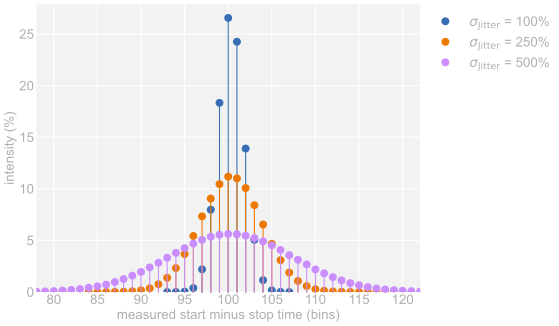
These histograms are dominated by the jitter and not the quantization error. They look completely different as the histograms shown in Case 1.
Since these histograms are dominated by the jitter and not the quantization error, one can estimate the magnitude of the jitter from them. For example, the standard deviation of the purple histogram data (with \(\sigma_{\mathrm{Jitter}}\) = 500%) is \(\sigma_{\mathrm{Hist}}\) = 708%, close to the expectation of \(\sqrt{2} \times \sigma_{\mathrm{Jitter}}\) (since the TDC performs two measurements, start and stop, the jitter applies twice, ergo the expected standard deviation of the histogram data is a factor \(\sqrt{2}\) larger than the standard deviation of the jitter).
Case 3 - TDC dominated by quantization error
Let’s now decrease the jitter to be much smaller than the bin size of the TDC.
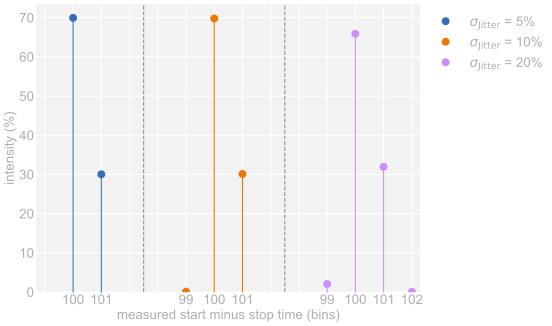
In the following figure, measurement of a constant delay of 100.3 is simulated multiple times with the same method as in Case 2, but with random errors of 5%, 10%, and 20% of the bin size.
One can see that at 5%, the histogram is virtually identical to the ideal Case 1 shown above. With increasing jitter, more output values appear, but, qualitatively, the histograms still resemble the ideal case.
Choosing a data bin size
Note
In the following, two different bin sizes are discussed.
The intrinsic bin size refers to the quantization the TDC chip performs, that is, what delta time corresponds to which code number.
The data bin size refers to the code numbers that are output to the user.
When designing a TDC, a manufacturer needs to choose a step size of the output data, that is, what output codes of the device correspond to what delta times in real life. This is often referred to as LSB (for Least Significant Bit). It tells us what delta time corresponds to the smallest change in the TDC output code. For example, for cronologic’s xTDC4, 1 LSB equals 13 ps.
Note that the choice of the data bin size is, in principle, arbitrary.
For instance, the natural choice of a data bin size for a perfect TDC is the intrinsic bin size of the TDC chip. Since the bins of a perfect TDC are all equally sized, without error, choosing a smaller LSB “wastes” output codes, that is, one needs larger numbers to represent delta times but without gaining any more information. Equally, choosing a larger LSB discards information.
The choice is less obvious for a real TDC with an intrinsic bin size masked by errors. These errors encompass jitter due to noisy signals, or jittering reference clocks, as well as the fact, that building a TDC with constant intrinsic bin sizes is virtually impossible. Do you choose a small data bin size that keeps the variation of measured delta times? Or, do you choose a data bin size corresponding to the average intrinsic bin size, or even larger?
The appropriate choice depends on something that, so far, was only passingly discussed.
Differential and integral nonlinearity
While non-constant intrinsic TDC bin sizes were mentioned, so far, they were generally mixed in with “general jitter errors.” If the bin size is unknown, this is valid. However, the intrinsic bin sizes of a TDC can be measured and calibrated, that is, one can create a look-up table assigning each TDC bin to its own corresponding delta time.
Every real TDC has differential and integral nonlinearities (DNL and INL). The DNL quantifies the size variation of consecutive bins. The INL corresponds to the mismatch of measured delta times assuming a constant bin size to real delta times.
One can measure the DNL and INL of a real TDC (for example, with a code density test), and then calibrate it.
Ergo, the errors resulting from the TDC’s DNL/INL can be corrected for, which makes these errors different from other timing jitter. However, calibration is not always possible, feasible, or practical, and never perfect. Thus, disregarding price point, a TDC with smaller DNL/INL is generally preferable to a TDC with larger DNL.
Implementing TDC chips such that they have a small DNL is expensive (monetary and/or in power consumption), which is why compromises have to be struck.
Nevertheless, returning to the question at hand: What data bin size is appropriate for my real TDC?
If you have a TDC with large DNLs but that is well calibrated, the intrinsic bin size of the TDC varies, but is known. Choosing a data bin size corresponding to the average intrinsic bin size now discards information. Some delta times are measured by your TDC with more precision, warranting a smaller data bin size, even though other delta times are measured with less precision.
Note, on average, the quantization error of a perfectly calibrated TDC with large DNL and smaller bin size is the same as the quantization error of a TDC with no DNL but larger bin size. Even if in the former case, the output data looks smoother (as the bin size is smaller), the underlying quantization error is the same.
The following animation highlights the difference of two such TDCs, comparing one with perfect DNLs and a large bin size to another with large DNLs and a small bin size.
Animation of the measurement principle
On the left, the constant delay dT is represented by a blue ruler with fixed length. The start (and stop) times increase continuously and are quantized by the TDC. The resulting measured dT is shown by the orange double-arrow above the ruler.
On the right, a histogram of continuously measured delay times is shown.
The top row of the animation represents a perfect TDC with perfect DNL. Each time gets sorted correctly into perfectly sized bins.
The bottom row represents a TDC with significant DNL but smaller data bin size.
One can see that after many measurements, the histogram of the lower case looks smoother, as more bins are filled. Both cases, however, ultimately measure the same dT (as shown by ⟨dT ⟩ above the histogram, which is the weighted average of the histogram). Note as well that the TDC with no DNL reaches the true dT with fewer measurements.
In this representation, the binsize is absolutely known, that is, no jitter is present. One could, as was done at the beginning of this application note, interpret the lower row of the animation as a TDC with significant jitter, which means that, effectively, the binsize is unknown. In this interpretation, the quantization error corresponds to the average bin size, while jitter is corresponds to the random distribution of bin sizes.
TDCs from cronologic
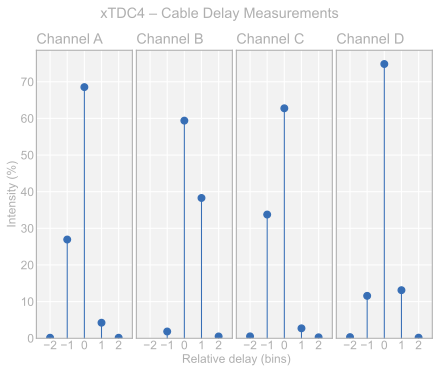
cronologic’s xHPTDC8 and xTDC4 are implemented using highly specialized integrated circuits, ensuring a small DNL. Additionally, we take special care designing our boards choosing components with low intrinsic jitter. In return, our TDCs do not introduce significant error other than the quantization error. This becomes apparent in the following histograms of a constant-delay test.
As one can see, the general shape of the histograms closely resembles those shown in Case 3: Our TDCs are dominated by quantization errors, not by other jitter.
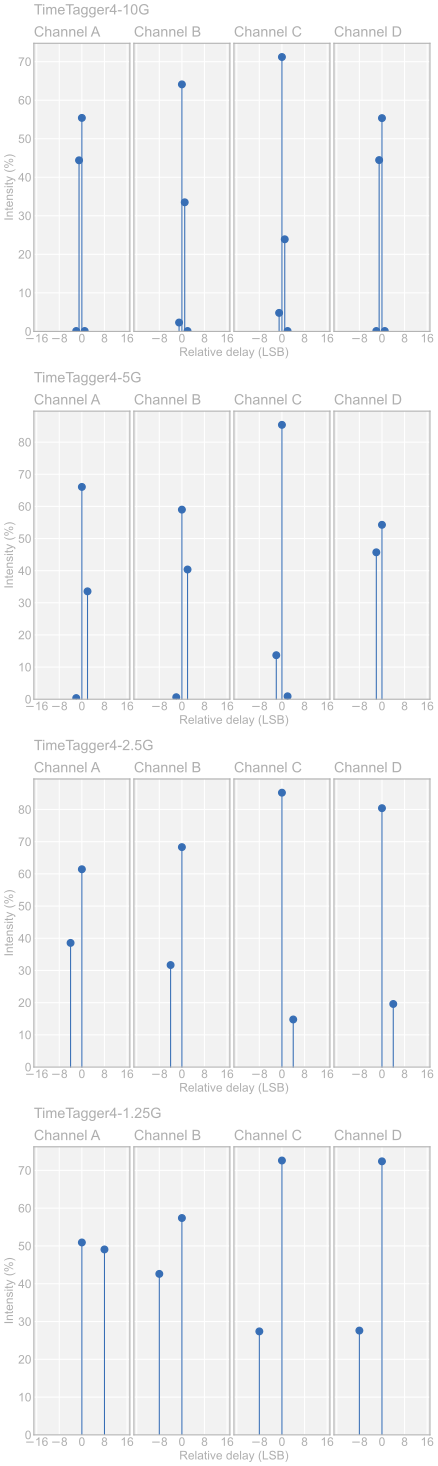
The errors present in TimeTagger series are almost exclusively quantization errors, as becomes apparent from the following histograms.